Case Study / AI & Automation · Own Build
AutoFlow: proposals that close themselves.
Project snapshot
Write the proposal, send a link, know the moment a client reads it, and watch the project open itself the second they say yes. AutoFlow is the AI-first client-ops platform we built for our own pipeline — and it runs on the same AI-first methodology we use on every client engagement.
AutoFlow — AI Proposal & Client-Ops Platform
AutoFlow is our internal AI R&D build: a proposal generation and client-ops platform that drafts proposals with AI, learns from the ones that actually won, tracks the moment a client opens a share link, and converts an accepted proposal straight into a live project with milestones — no manual handoff.
Challenge framing
The problem.
Key tensions
- 1 Speed
- 2 Generic AI output
- 3 No learning loop
Every new lead means another proposal written from scratch. Generic AI tools produce generic proposals that read like everyone else's. And nothing in a typical stack learns from the proposals that actually won — every draft starts from zero, forever.
-
Speed
Hours lost per proposal is hours not spent delivering client work.
-
Generic AI output
Off-the-shelf AI writing tools with no context on the business or what has actually worked before.
-
No learning loop
Past wins and losses sit in inboxes instead of informing the next draft.
Implementation
The solution.
We built a FastAPI + React platform on Supabase (Postgres + pgvector), with two AI paths: Gemini for fast first drafts, and a fine-tuned Llama 3 model trained on real proposal-writing style. Every sent proposal is embedded and indexed — when a new one is drafted, AutoFlow retrieves the closest past won proposals as reference, so its suggestions improve with every deal that closes. Acceptance auto-converts a proposal into a live project with milestone tracking, and every share link reports back the moment a client opens it.
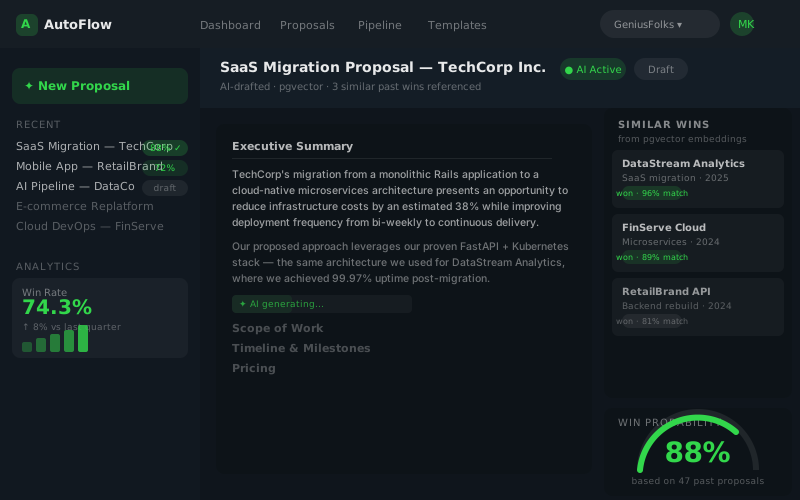
Gemini-powered proposal drafting with company-context injection
Fine-tuned Llama 3 pipeline trained on real proposal-writing style
pgvector embeddings retrieve the closest past won deals as reference
Shareable proposal links with real-time view and delivery tracking
One-click conversion from an accepted proposal into a live project
Milestone tracking with progress and custom stages
Multi-tenant workspaces secured with row-level security per user
AI usage rate-limiting to keep generation costs predictable
Tools we shipped with
FastAPI and Supabase handled data, auth, and row-level security; React drove the dashboard; pgvector turned every past proposal into a retrievable reference for the next one.
What made this hard
Fine-tuning Llama 3
Training a base model on real proposal-writing style without it turning generic or repetitive.
Win-history learning
Turning past won proposals into embeddings the generator can retrieve and actually use as reference.
Multi-tenant security
Row-level security so every workspace's clients, proposals, and embeddings stay isolated.
AI cost control
Rate-limiting generation per user so AI spend stays predictable at scale.
A pipeline that learns.
What AutoFlow's AI-first architecture delivers today.
AI models in the pipeline
Gemini for speed, fine-tuned Llama 3 for style
Proposal → project conversion
No manual handoff after a client says yes
Multi-tenant security
Delivery & view tracking
Win-history learning
Want an AI system like this in your business?
Book a free 30-minute strategy call. We will scope the work, share a fixed-fee proposal, and start within two weeks.